
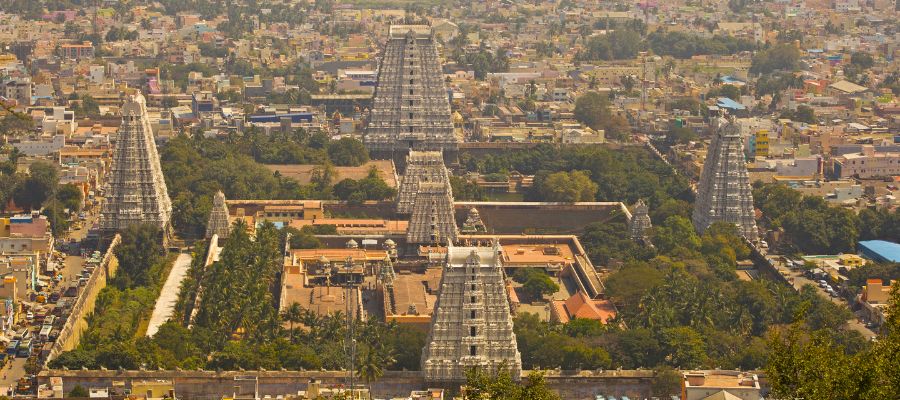
Introduction: One of the Greatest Shaivite Temples in India
Arunachaleswarar Temple is one of the most significant and ancient Shiva temples in India, located in the town of Tiruvannamalai in Tamil Nadu. Dedicated to Lord Shiva as Arunachaleswarar, the temple stands at the base of the sacred Arunachala Hill and forms the spiritual core of the region. It is one of the Pancha Bhoota Sthalams, where Shiva is worshipped as the element of fire (Agni).
For devotees, Arunachaleswarar Temple is a major pilgrimage centre associated with deep spiritual traditions. For visitors, it represents a monumental expression of Dravidian temple architecture, religious history, and living ritual culture, making it one of the most influential sacred sites in South India.
Historical Origins and Dynastic Patronage
The origins of Arunachaleswarar Temple trace back to ancient Shaivite traditions and early Tamil devotional literature. The site was revered long before the construction of the present monumental structures, with Arunachala Hill itself regarded as a manifestation of Shiva.
The temple underwent major architectural expansion under successive dynasties, especially the Cholas, Pandyas, Vijayanagara rulers, and Nayaks. Each dynasty contributed gopurams, mandapams, walls, and corridors, transforming the temple into a vast fortified complex.
Numerous inscriptions found within the temple record land grants, endowments, and royal patronage, offering insights into medieval South Indian administration and temple economy. Over centuries, Arunachaleswarar Temple evolved into a powerful religious and institutional centre.
Architecture and Sacred Space
Arunachaleswarar Temple is one of the largest temple complexes in Tamil Nadu. The temple is enclosed by massive granite walls and features multiple towering gopurams, the most prominent being the eastern Rajagopuram, one of the tallest temple towers in South India.
The complex contains expansive courtyards, long pillared corridors, intricately carved mandapams, and multiple shrines dedicated to Shiva, Parvati (Unnamalai Amman), and other deities. Sacred tanks, ritual halls, and processional routes form an integrated sacred space within the temple precinct.
The architectural scale and spatial organisation reflect the political power and religious vision of the medieval South Indian kingdoms that shaped the temple over centuries.
Religious and Cultural Importance
Arunachaleswarar Temple holds immense importance in Shaivism. It is associated with major festivals such as Karthigai Deepam, when a giant flame is lit atop Arunachala Hill, attracting millions of devotees. Other important festivals include Brahmotsavam, Maha Shivaratri, and Girivalam-related observances.
The temple is also closely connected to spiritual traditions of meditation and renunciation. The presence of sages, saints, and ashrams around Tiruvannamalai has strengthened its reputation as a centre of spiritual practice.
Beyond worship, the temple has influenced Tamil religious literature, temple music, and ritual traditions, shaping the cultural identity of the region.
Experience for Visitors and Travellers
For visitors, Arunachaleswarar Temple offers a comprehensive experience of devotion, architecture, and pilgrimage culture. Devotees participate in rituals, darshan, and festivals, while cultural travellers explore the monumental architecture and sculptural details.
Tourists often combine temple visits with Girivalam around Arunachala Hill, ashram visits, and exploration of Tiruvannamalai town. The temple’s scale and vibrant activity provide insight into the functioning of a major South Indian pilgrimage centre.
The temple’s atmosphere, marked by chants, bells, lamps, and crowds, creates a dynamic spiritual environment that distinguishes it from smaller shrines.
Role in Tiruvannamalai’s Religious and Urban Identity
Arunachaleswarar Temple plays a defining role in Tiruvannamalai’s identity as a sacred town. The temple acts as the nucleus around which the town’s religious, economic, and social life developed.
Markets, streets, ashrams, and residential areas historically evolved in relation to the temple’s spatial layout. The temple also connects Tiruvannamalai to broader Shaivite pilgrimage networks across India.
In the wider context of South Indian temple towns, Arunachaleswarar Temple exemplifies the integration of monumental architecture, ritual practice, and urban growth.
Arunachaleswarar Temple in the Modern Era
In the modern era, Arunachaleswarar Temple continues to function as one of India’s most active centres of Shiva worship. Restoration projects, temple administration reforms, and heritage conservation initiatives have supported the preservation of its vast architectural complex.
The temple has become a central destination in Tamil Nadu’s religious tourism circuits, attracting pilgrims, spiritual seekers, and heritage travellers from across India and abroad. At the same time, traditional rituals, large-scale festivals, and daily worship remain integral to temple life.
As Tiruvannamalai expands and modern infrastructure grows around the temple, Arunachaleswarar Temple continues to serve as a focal point of devotion, heritage, and community life, maintaining its historical prominence while engaging with contemporary patterns of pilgrimage and tourism.