
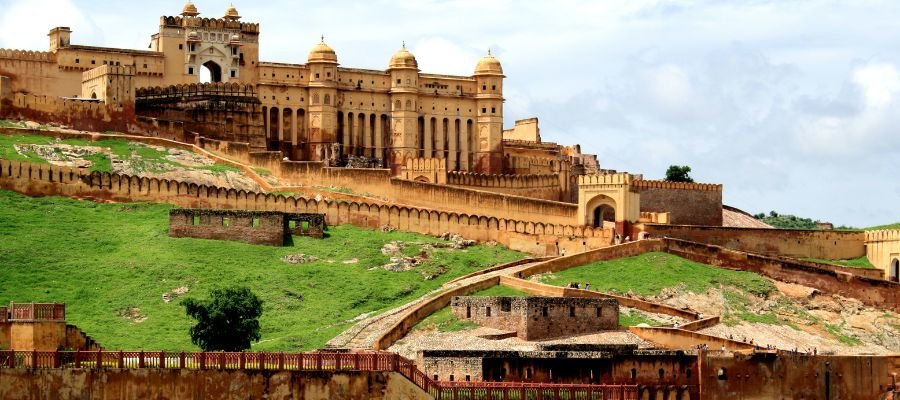
Amber Fort sits on a rugged hill above Maota Lake and looks like a complete royal city in itself. As you enter through the huge gates and climb the cobbled paths, you move through a series of courtyards, each opening into grand halls, mirrored chambers and cool shaded corridors. The Diwan-e-Aam (Hall of Public Audience), Diwan-e-Khas (Hall of Private Audience), Sheesh Mahal (mirror palace) and Sukh Niwas (where cool air was created by passing wind over water channels) show how cleverly Rajput rulers combined luxury with climate-sensitive design. Red sandstone and pale marble glow differently through the day, while views from the ramparts take in the lake, surrounding hills and the old town of Amer below. Light-and-sound shows at night and the temple of Shila Devi at the entrance keep the fort alive both as a heritage monument and an active place of worship.
About this place
History & highlights
The area of Amer was originally a Meena settlement, said to be established by Raja Alan Singh of the Meena Chanda clan around the 10th century. The present Amber palace–fort complex was begun in 1592 by Raja Man Singh I, one of Akbar’s most trusted Rajput generals, and then enlarged by his successors, especially Jai Singh I and Sawai Jai Singh II. The fort’s courtyards, gateways and palaces were added in phases as the Kachwaha rulers grew in power under the Mughals, blending Rajput planning with Mughal decorative styles. When Sawai Jai Singh II shifted his capital from Amer to the newly planned city of Jaipur in 1727, Amer remained the old royal seat but slowly lost its political importance. In 2013, Amber Fort was included in the UNESCO World Heritage serial site “Hill Forts of Rajasthan,” recognising it as a classic example of Rajput hill-fort architecture.
Reviews
No reviews yet. Click “Write a Review” above to share your experience.