
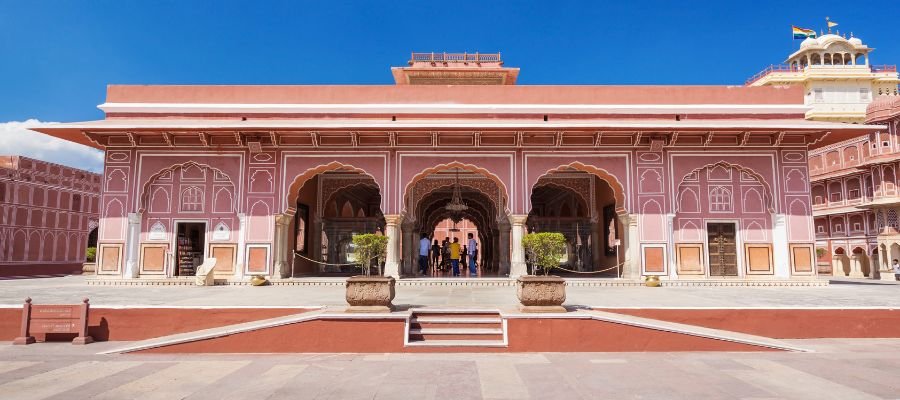
City Palace is like a city inside the city – a maze of courtyards, gateways, painted halls and royal apartments right in the heart of the walled Pink City. Visitors first see the tall gateways and cream-and-pink façades, then step into courtyards where peacock-motif gates, marble pillars and jharokha balconies mix Mughal, Rajput and European influences. Parts of the complex function as museums, displaying royal costumes, weapons, palanquins and carpets, while other sections, especially Chandra Mahal, are still used by the former ruling family. The palace also houses the Govind Dev Ji temple complex, so the rhythm of daily worship, festivals and aarti continues inside. Because of its central location and active use, City Palace becomes the living heart of Jaipur’s royal heritage, not just a static monument.
About this place
History & highlights
The City Palace complex is directly linked to the founding of Jaipur. Maharaja Sawai Jai Singh II, ruler of Amber, decided to shift his capital to a new site around 1727 due to population growth and water scarcity at Amer. He planned Jaipur as a grid-based city inspired by Vastu Shastra and other classical treatises, and chose a hunting lodge site on the plains for the palace. Under his guidance and that of chief architect Vidyadhar Bhattacharya, the first parts of City Palace and its enclosing walls were built in the early 18th century and later expanded by his descendants. Over time, structures like Mubarak Mahal, Sarvato Bhadra and Sabha Niwas were added, reflecting changing tastes under later rulers and the British Raj. Even after independence, the royal family retained residence in parts of Chandra Mahal while opening other sections as a museum, making the palace a bridge between Jaipur’s royal past and modern identity.
Reviews
No reviews yet. Click “Write a Review” above to share your experience.