
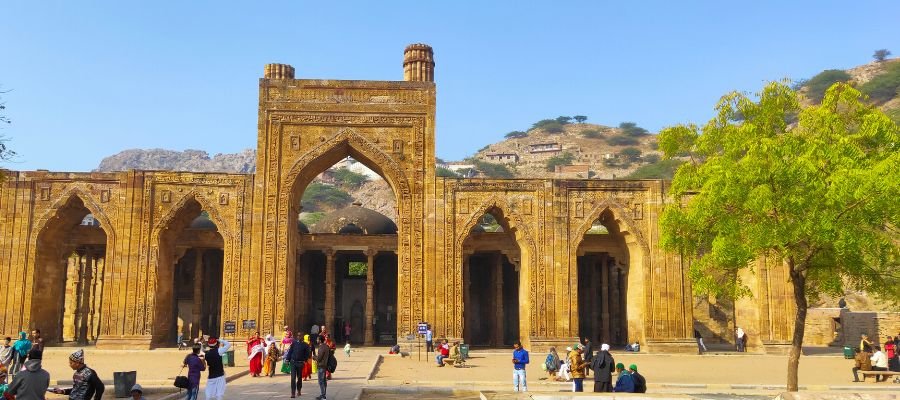
Adhai Din Ka Jhonpra sits on a slight rise not far from the Dargah, an impressive forest of stone pillars and arches that looks half-temple, half-mosque. From the front you see a massive screen of pointed arches with Quranic inscriptions; inside the prayer hall, rows of carved pillars and old temple motifs support the roof, creating a unique Indo-Islamic atmosphere. Even in ruins it feels powerful: fragments of floral carving, Sanskrit fragments, and Islamic calligraphy all exist together in one complex, making it one of India’s most striking early mosques and a key stop for anyone interested in architecture or history.
About this place
History & highlights
The site originally housed a Sanskrit college and/or Hindu-Jain temples during the Chauhan dynasty. In 1192 CE, after Sultan Muhammad Ghori defeated Prithviraj Chauhan, his general Qutb-ud-Din Aibak captured Ajmer and ordered the conversion of this complex into a mosque. Aibak had a seven-arched screen erected in front of the pillared halls and reused carved pillars, capitals and slabs from pre-existing temples—making Adhai Din Ka Jhonpra one of the earliest large Indo-Islamic mosques in North India. Further enhancements were made by Iltutmish around 1213 CE. Its name (“shed of two and a half days”) is explained by local legends—that it was built in two-and-a-half days, or used briefly for a religious fair—but historians see the phrase more as folklore than literal fact. Today the monument is protected and interpreted as a rare surviving example of the transition from temple to mosque architecture.
Reviews
No reviews yet. Click “Write a Review” above to share your experience.