
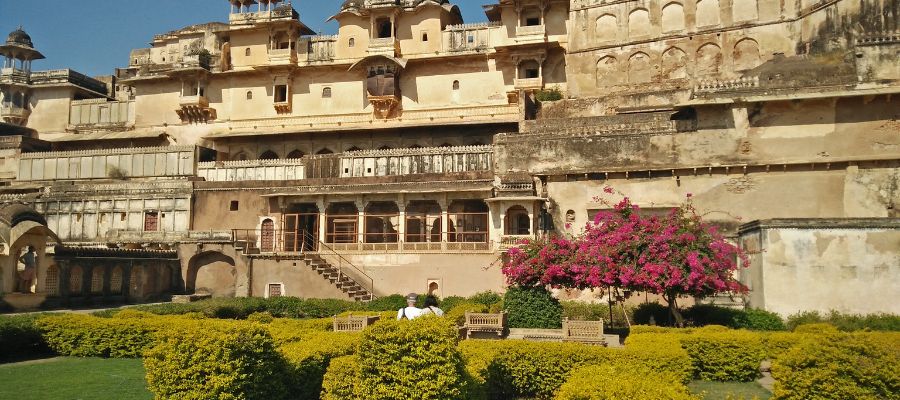
Garh Palace (often just called Bundi Palace) rises almost vertical above the old town, a long line of terraces, arches and chhatris clinging to the hill below Taragarh Fort. From the outside it looks like a single giant structure, but inside it is a maze of separate palaces—Ratan Mahal, Badal Mahal, Chhatra Mahal, Phool Mahal—built at different times. Many rooms preserve superb Bundi school frescoes: Krishna leelas, court scenes, hunting, monsoon clouds, painted in soft blues and greens. The most famous section is Chitrashala (Ummed Mahal), an open courtyard with arcades fully covered in paintings; standing here feels like standing inside a giant miniature painting. From palace balconies you see Bundi’s blue houses and Nawal Sagar Lake spread out below.
About this place
History & highlights
Bundi became the capital of the Hada Chauhan Rajputs in the late 13th century, when Rao Deva founded the state. Early palaces on the hillside started under Raja Rao Ratan Singh (r. c. 1607–1631) and were expanded by successors, especially Rao Chhatra Sal (r. 1658–1688) and later rulers. The Bundi school of painting flourished here from the 17th–18th centuries, influenced by Mughal art but very distinctive in its love for monsoon, gardens and palace terraces. Many of the best works are in Chitrashala, commissioned by Maharao Ummed Singh (r. 1749–1770) as a pleasure pavilion decorated with Krishna themes. In the 20th century, after the royal family shifted to more modern residences, parts of the palace fell into disrepair; recent years have seen conservation by the state and private initiatives, and it is now recognised as one of India’s most important painted palaces.
Reviews
No reviews yet. Click “Write a Review” above to share your experience.