
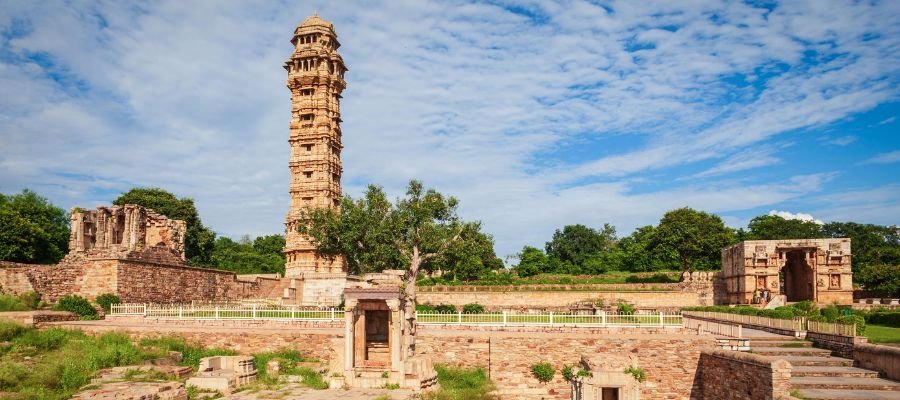
Rising about 37 m into the sky, Vijay Stambh is the fort’s most striking vertical landmark. The nine-storey tower is richly carved on all sides with images of gods, goddesses, warriors, floral bands and inscriptions. From a distance you see it standing tall above lawns and ruins; up close, every level has projecting balconies and miniature pavilions. Narrow internal staircases lead (when open) to the top, where balconies offer sweeping views of the fort and surrounding countryside. At night, floodlighting makes the sandstone glow golden against the dark plateau.
About this place
History & highlights
Vijay Stambh was built between 1440–1448 CE by Rana Kumbha, one of Mewar’s greatest rulers, to commemorate his victory over the combined armies of Mahmud Khalji of Malwa and the Sultan of Gujarat. Inscriptions on the tower record genealogies, achievements and devotion, turning it into a stone manifesto of Kumbha’s rule. Architecturally it represents the peak of 15th-century Rajput temple-tower style adapted to a secular victory monument. Later rulers preserved it with repairs, and in colonial times it became a major subject for photographers and travellers. Today, along with Padmini Palace, it is the image most used to represent Chittorgarh Fort in tourism and heritage writing.
Reviews
No reviews yet. Click “Write a Review” above to share your experience.