
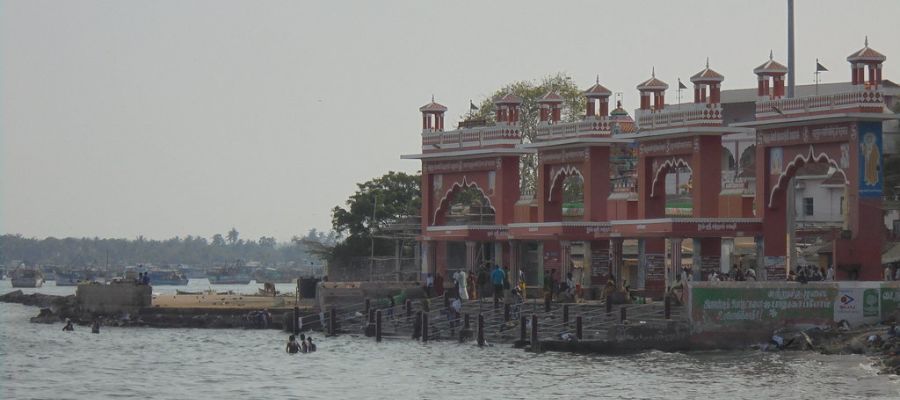
Introduction: Sacred Waters at the Temple Shore
Agni Theertham is one of the most sacred and symbolically powerful pilgrimage sites in Rameswaram. Located on the seashore directly opposite the Ramanathaswamy Temple, this holy stretch of water forms an essential part of the town’s spiritual identity. Unlike inland temple tanks, Agni Theertham is not enclosed by walls or architecture—it is the open sea itself, transformed into a sacred ritual space by centuries of belief and tradition.
For pilgrims and travellers, Agni Theertham represents the moment where spirituality meets nature. The sound of waves, the vast horizon, and the presence of devotees performing rituals together create an atmosphere that feels both elemental and sacred. It is not merely a beach; it is a living sacred landscape where faith, water, and myth converge.
Mythological Significance in the Ramayana
The spiritual importance of Agni Theertham is deeply connected to the Ramayana. According to tradition, after defeating Ravana in Lanka, Lord Rama worshipped Lord Shiva at Rameswaram to atone for the sin of killing a Brahmin king. Before entering the Ramanathaswamy Temple, Rama is believed to have bathed in the sea at Agni Theertham as an act of purification.
Another legend associates the site with the fire god Agni, from whom the Theertham derives its name. The sacred waters are believed to carry divine energy, capable of cleansing sins and granting spiritual merit. These mythological narratives elevate Agni Theertham beyond a natural shoreline, transforming it into a ritual threshold between the physical and spiritual worlds.
Role in Hindu Pilgrimage Tradition
In Hindu pilgrimage practice, sacred baths are considered essential acts of purification before temple worship. Agni Theertham plays this role in Rameswaram’s pilgrimage circuit. Pilgrims traditionally begin their spiritual journey here before proceeding to the Ramanathaswamy Temple and its famous 22 holy wells.
This sequence reflects the layered nature of Hindu ritual geography: first the open sea (Agni Theertham), then temple wells, and finally the sanctum of Lord Shiva. Agni Theertham thus functions as the starting point of spiritual transformation, where devotees symbolically leave behind worldly impurities before entering sacred space.
Landscape and Sensory Experience
Unlike enclosed holy tanks, Agni Theertham is defined by openness. The vast expanse of the sea, the constant movement of waves, and the wide sky create a sense of infinity. This natural setting amplifies the spiritual experience, making rituals feel cosmic rather than confined.
Early mornings and evenings are especially significant at Agni Theertham. At dawn, pilgrims gather quietly to perform rituals in the soft light, while at sunset, the shoreline transforms into a dramatic stage of colours and reflections. The interplay of light, water, and human presence creates a powerful visual and emotional experience.
Experience for Pilgrims and Travellers
For pilgrims, bathing at Agni Theertham is an act of faith and devotion. The ritual is often accompanied by prayers, offerings, and moments of introspection. Many devotees believe that a dip in these waters brings spiritual merit and blessings.
For travellers and cultural explorers, Agni Theertham offers insight into living religious traditions. Observing pilgrims performing rituals in the open sea reveals how spirituality in India is deeply integrated with nature. Even visitors who are not religious often feel the intensity of the atmosphere, where belief and environment merge seamlessly.
The site also appeals to photographers and storytellers. The contrast between temple towers in the background and the open sea in the foreground creates striking visual compositions. Human figures performing rituals against the vast ocean add depth and meaning to the landscape.
Symbolism of Fire and Water
The name “Agni Theertham” itself carries symbolic meaning. Agni, the fire god, represents purification, transformation, and divine witness in Hindu tradition. The union of Agni (fire) with Theertham (water) symbolises the balance of opposing elements.
In a deeper sense, Agni Theertham represents the meeting of inner transformation and external ritual. The act of bathing in the sea becomes a metaphor for spiritual renewal. For visitors, this symbolism adds philosophical depth to the experience, transforming a simple coastal site into a space of existential reflection.
Role in Rameswaram’s Sacred Geography
Agni Theertham plays a central role in shaping Rameswaram’s sacred geography. While the Ramanathaswamy Temple represents architectural and ritual grandeur, Agni Theertham represents the primal element of water. Together, they create a holistic spiritual landscape where temple and nature are inseparable.
The proximity of Agni Theertham to other sacred sites such as Rama Setu, Gandamadana Parvatham, and Kothandaramaswamy Temple further integrates it into the broader Ramayana narrative. It serves as a connecting link between mythological geography and living ritual practice.
Cultural and Social Significance
Beyond religion, Agni Theertham is a social space where community and tradition intersect. Festivals, pilgrimages, and collective rituals bring together people from different regions and backgrounds. The shoreline becomes a temporary community, united by shared belief and experience.
For local residents, Agni Theertham is not only a sacred site but also a part of everyday life. Its presence shapes the rhythm of Rameswaram, influencing religious practices, tourism, and cultural identity.
Agni Theertham in the Present Day
Today, Agni Theertham remains one of the most important and vibrant spiritual spaces in Rameswaram. Despite modern tourism and infrastructure, the essence of the site has remained unchanged. Pilgrims continue to gather at the shoreline, performing rituals that have been practised for centuries.
As Rameswaram evolves as a pilgrimage and tourist destination, Agni Theertham retains its relevance as a space where tradition meets nature. It stands as a reminder that spirituality is not confined to temples but also lives in landscapes and elements.
Ultimately, Agni Theertham is more than a sacred beach—it is a ritual threshold, a mythological site, and a cultural landscape. For visitors, it offers a rare opportunity to witness the living relationship between faith and nature. By blending myth, ritual, and oceanic grandeur, Agni Theertham continues to define the spiritual soul of Rameswaram, making it one of the most evocative sacred spaces in India’s coastal heritage.