
Introduction and Historical Context
Arikamedu is one of the most significant archaeological sites in Puducherry and a rare window into the city’s ancient past. Located on the banks of the Ariyankuppam River, a few kilometres south of modern Puducherry, Arikamedu was once a thriving port settlement that connected the Indian subcontinent with the wider ancient world. Unlike the French Quarter, which reflects colonial history, Arikamedu represents a much older layer of civilisation, revealing that Puducherry’s global connections began long before the arrival of European powers.
For travellers who are fascinated by ruins, archaeology, and deep history, Arikamedu offers a unique experience. The site evokes imagination rather than spectacle, inviting visitors to visualise ancient ships, traders, and bustling port life that once flourished along this quiet riverbank.
Ancient Trade and Global Connections
Arikamedu rose to prominence around the early centuries BCE and CE, during a period when maritime trade between India and the Mediterranean world was expanding rapidly. Archaeological excavations have revealed Roman coins, amphorae, pottery, beads, and other artefacts that testify to active trade with the Roman Empire. Goods such as spices, textiles, gemstones, and perfumes were exported from this region, while luxury items from Rome and West Asia reached the Indian coast.
These discoveries demonstrate that Arikamedu was not an isolated settlement but part of a vast international trading network. The site highlights how the Coromandel Coast served as a bridge between South Asia, Southeast Asia, and the Mediterranean world. In this sense, Arikamedu reveals Puducherry’s ancient identity as a global maritime hub long before modern tourism and colonial influence.
Archaeological Discoveries and Research
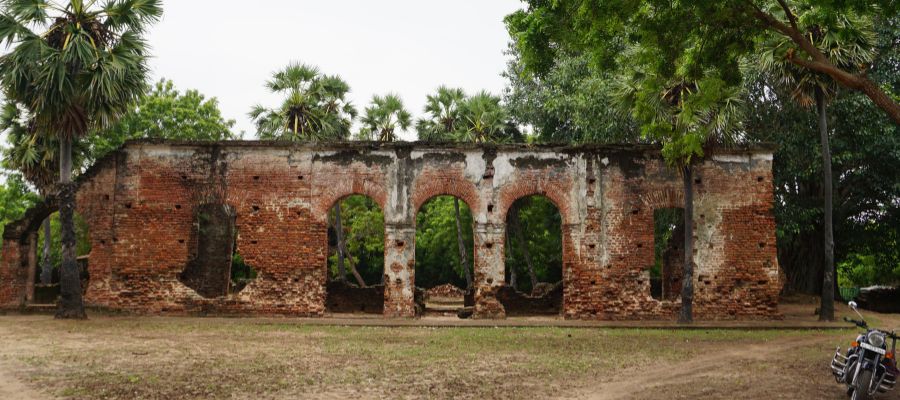
Arikamedu gained scholarly attention in the twentieth century when systematic excavations were conducted by archaeologists, including Sir Mortimer Wheeler. Their work uncovered remains of brick structures, warehouses, docks, and industrial areas, suggesting that Arikamedu functioned as a well-organised port town. The presence of Indo-Roman artefacts provided concrete evidence of cultural and economic exchange between India and the West.
Over time, further studies revealed that Arikamedu was not limited to Roman trade alone. The site also showed signs of local industries, craftsmanship, and long-term habitation, indicating that it was an important centre of production as well as commerce. Today, the ruins stand as silent witnesses to centuries of maritime activity and cross-cultural interaction.
A Different Experience from French Puducherry
Visiting Arikamedu feels markedly different from walking through Puducherry’s French Quarter. While White Town is vibrant, architectural, and visually striking, Arikamedu is quiet, open, and reflective. There are no grand buildings or colourful streets here; instead, there are broken walls, weathered bricks, and traces of ancient foundations. This simplicity allows visitors to engage with history in a more imaginative and contemplative way.
Standing amid the ruins, one can picture ancient ships arriving at the port, merchants negotiating trade, and workers unloading goods along the riverbank. The absence of modern distractions makes Arikamedu a space where history feels tangible, even though much of it must be reconstructed through imagination.
Importance for Heritage Tourism
Arikamedu holds special value for travellers who want to explore Puducherry beyond cafés, beaches, and colonial architecture. It adds depth to the city’s historical narrative, showing that Puducherry’s identity is not limited to the French period but rooted in much older civilisations. For history enthusiasts, students, and researchers, the site offers insights into ancient trade, urban planning, and cultural exchange.
As a heritage destination, Arikamedu complements Puducherry’s better-known attractions. While the promenade and French Quarter represent the colonial past, Arikamedu represents the ancient foundations of the city. Together, these sites create a layered historical landscape that spans thousands of years.
Cultural and Educational Significance
Beyond tourism, Arikamedu plays an important role in understanding India’s maritime history. It challenges the idea that globalisation is a modern phenomenon by demonstrating that ancient India was already connected to distant regions through trade and cultural exchange. The site also contributes to academic research in archaeology, history, and ancient economics.
For local communities, Arikamedu serves as a reminder of Puducherry’s long and complex heritage. It reinforces the idea that the city’s identity was shaped not only by colonial powers but also by indigenous traditions and ancient global interactions.
Arikamedu in the Present Day
Today, Arikamedu stands as a quiet yet powerful heritage site that enriches Puducherry’s historical identity. Though less crowded than the city’s popular tourist spots, it offers a meaningful experience for those who seek deeper connections with the past. The site symbolises Puducherry’s ancient global links and its role in early maritime trade.
Ultimately, Arikamedu represents the hidden historical layer of Puducherry. While modern visitors often associate the city with French architecture and seaside charm, Arikamedu reveals a much older story—one of ancient ports, international trade, and cultural exchange. It reminds travellers that Puducherry’s connection to the world did not begin with colonialism but was already established thousands of years ago, making Arikamedu an essential destination for anyone who wishes to understand the city beyond its surface beauty.