
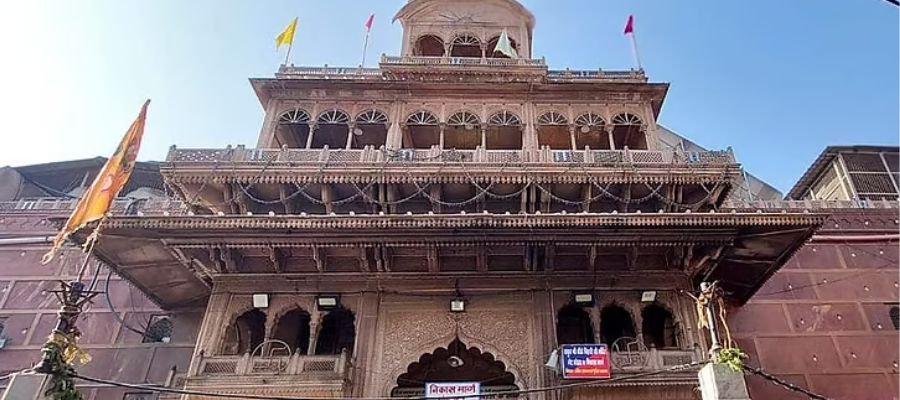
Banke Bihari Temple, Vrindavan: Where Every Glance Feels Like Grace
There’s a particular kind of madness that descends on Vrindavan’s narrow lanes during the hours of morning darshan. Auto-rickshaws honk past flower sellers who squat on every corner, arms deep in marigold and rose offerings. The smell of incense thickens the air. Pilgrims move in waves — some barefoot, some chanting, some simply swept along by the crowd. And at the centre of all of it, tucked behind winding streets that feel deliberately designed to make you slow down, stands Banke Bihari Temple.
The moment you pass through its arched entrance, something shifts.
Unlike the grand, fortress-like temples that dominate many pilgrimage towns, Banke Bihari feels intimate — almost domestic in its warmth. The hall is not enormous, but it is always full, and the energy inside is unlike anywhere else in Vrindavan. People don’t stand still here. They sway. They clap. They call out to Krishna in a voice that sits somewhere between prayer and laughter. The atmosphere is less solemn temple, more joyful reunion.
The Lord Who Stands Bent
The name itself tells you everything you need to know about the deity. Banke means bent in three places, and Bihari means one who roams or delights. The idol of Banke Bihari depicts Krishna in his famous tribhanga posture — hips swayed to one side, body gently curved, flute resting in hand. It is a posture of ease, of play, of someone completely at home in his own skin. Devotees will tell you that this form of Krishna is not distant or majestic — he is present, mischievous, and deeply approachable.
The deity was discovered in the 16th century by the saint-composer Swami Haridas, the revered guru of the legendary musician Tansen. According to temple lore, the idol emerged from a grove in Nidhivan — a sacred forest nearby — in response to Haridas’s devotional singing. That same spirit of music has never quite left the temple. Walk in during kirtan and you’ll understand what Haridas must have felt.
The Curtain That Opens and Closes
For first-time visitors, the experience can be startling and oddly moving. The priest draws a curtain across the sanctum at regular intervals — covering the deity, then revealing him again, then covering him once more. This isn’t interruption; it is the ritual itself.
The tradition holds that the direct, unbroken gaze of Banke Bihari is so potent, so charged with divine energy, that it must be rationed — not because Krishna withholds, but because the human heart can only absorb so much at once. Each parting of the curtain becomes a small moment of held breath. Each closing becomes the ache of longing. And that push-pull, that repeated cycle of seeing and not seeing, mirrors the very essence of devotion in the Vaishnava tradition: the heart reaching endlessly for what it loves.
Regulars here say you stop noticing the curtain after a while. Instead, you start noticing your own state — how the chest tightens slightly when it falls, how something releases when it lifts.
Festivals That Spill Into the Streets
If regular days at Banke Bihari are alive, festivals are another thing entirely.
Holi here is legendary for reasons that go beyond colour. The temple’s Holi celebrations begin weeks before the calendar date, and the tradition of phoolon ki Holi — a shower of flower petals instead of coloured powder — draws visitors from across the country. The petals drift down from above the sanctum in slow, surreal cascades while the crowd below erupts in song. It is one of those rare experiences that photographs cannot quite capture, because what’s missing in the image is the sensation of being inside it.
Jhulan Yatra, the swing festival, transforms the inner sanctum with elaborate floral decorations and a jewelled swing for the deity. Devotees take turns gently pushing the swing, singing traditional jhulan songs as the summer heat softens into evening. The ritual is tender, parental almost — as if the entire congregation is caring for a beloved child.
Janmashtami, Krishna’s birthday, brings the kind of crowd that makes the lanes around the temple feel like a river in full flood. But even in that press of bodies, there is a sweetness to it — strangers sharing prasad, elderly pilgrims helped along by younger hands, the whole neighbourhood dissolving into one extended family for a night.
More Than a Pilgrimage Stop
What distinguishes Banke Bihari from other temples on the Vrindavan circuit is harder to articulate than it is to feel. There are older temples, grander ones, temples with more elaborate rituals and better facilities. But few temples manage to make you feel so immediately, so personally welcomed.
Perhaps it is the theology that underlies the worship here — the Pushti Marg tradition, founded by the philosopher-saint Vallabhacharya, which holds that devotion to Krishna is not duty or discipline but grace. You do not earn your way to the Lord by suffering or rigour. You are simply drawn in by love, the way iron filings are drawn to a magnet, helpless and willing at once.
Or perhaps it is simpler than that. Perhaps it is just the curtain opening and closing, and the small human gasp each time it does.
Banke Bihari Temple is open for darshan in the morning and evening, with timings varying by season. The temple is located in the heart of Vrindavan town and is best reached on foot through the lanes from Loi Bazaar. Photography inside the sanctum is not permitted, and devotees are expected to follow the temple’s dress code.