
Introduction and Spiritual Identity
Bhagavathy Amman Temple is the spiritual heart of Kanyakumari and one of the most ancient and revered temples in South India. Dedicated to Goddess Bhagavathy, a powerful form of Shakti, the temple stands at the southern tip of India where land meets the vast seas. Unlike many temples that are known primarily for architecture or ritual grandeur, Bhagavathy Amman Temple is defined by its deep mythological significance, living traditions, and sacred geography.
For visitors, the temple represents more than a religious site—it is a place where mythology, history, and the natural landscape merge. The sound of temple bells, the presence of devotees, and the proximity of the sea create a unique spiritual atmosphere that feels timeless and intense. In Kanyakumari’s landscape of monuments and beaches, Bhagavathy Amman Temple remains the core sacred landmark around which the town’s identity has evolved.
Mythological Origins and Sacred Legends
The temple’s origins are deeply rooted in Hindu mythology. According to legend, Goddess Parvati performed severe penance here to win the hand of Lord Shiva. The goddess is believed to have remained in a state of eternal waiting when her marriage was disrupted, giving rise to the spiritual aura of Kanyakumari. The name “Kanyakumari” itself is derived from the word “Kanya,” meaning virgin, referring to the goddess in her unmarried form.
Another popular legend connects the temple with the defeat of the demon king Banasura. Goddess Bhagavathy is believed to have destroyed him after intense battle, symbolising the triumph of divine power over evil. These myths have shaped the temple’s rituals and cultural memory for centuries, making it not only a place of worship but also a repository of sacred stories.
Historical Development and Temple Heritage
Historically, Bhagavathy Amman Temple has been a centre of worship for over a thousand years. References to the temple appear in ancient texts, inscriptions, and regional traditions. Over time, various dynasties and local rulers contributed to its maintenance and expansion, ensuring its continuity through political and social changes.
Unlike grand imperial temples built by powerful empires, Bhagavathy Amman Temple reflects a more organic evolution. Its architecture, rituals, and community practices developed gradually, shaped by local devotion and regional culture. This continuity gives the temple a living heritage character rather than a purely monumental identity.
Architecture and Sacred Space
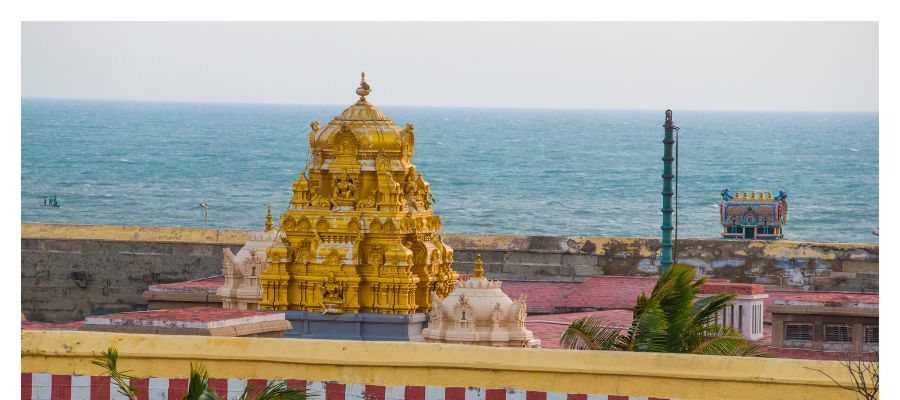
Architecturally, Bhagavathy Amman Temple follows the Dravidian temple tradition, with a gopuram (gateway tower), inner sanctum, and surrounding corridors. The temple’s structure is relatively modest compared to large South Indian temple complexes, but its spiritual intensity compensates for architectural simplicity.
The sanctum houses the idol of Goddess Bhagavathy adorned with jewels and ornaments. One of the most distinctive features of the temple is the goddess’s diamond nose ring, which is said to reflect sunlight and moonlight. According to tradition, the brilliance of the jewel once misled sailors at sea, leading to the restriction of its full display.
The temple’s location near the sea adds a unique dimension to its sacred space. The proximity of waves, wind, and open horizon creates a sensory experience that distinguishes it from inland temples. Here, nature itself seems to participate in the act of worship.
Role in Kanyakumari’s Cultural Landscape
Bhagavathy Amman Temple is central to Kanyakumari’s cultural and social life. It is not only a religious institution but also a focal point for festivals, rituals, and community gatherings. Major celebrations such as Navaratri, Chitra Pournami, and temple festivals attract thousands of devotees from Tamil Nadu and beyond.
The temple’s influence extends beyond religion into local identity. Kanyakumari’s name, traditions, and collective memory are closely tied to the goddess. While monuments like Vivekananda Rock Memorial and Thiruvalluvar Statue represent philosophical and cultural ideals, Bhagavathy Amman Temple represents the town’s spiritual foundation.
Experience for Devotees and Travellers
For devotees, the temple is a place of intense faith and emotional connection. Rituals, prayers, and offerings create a rhythm that has continued for generations. Many pilgrims visit the temple as part of spiritual journeys across South India, considering it one of the most powerful Shakti shrines.
For travellers, Bhagavathy Amman Temple offers a layered experience. Beyond religious rituals, visitors encounter living traditions, sacred architecture, and mythological narratives. Even those unfamiliar with Hindu practices often feel the atmosphere of devotion and antiquity that surrounds the temple.
The temple’s location near major tourist landmarks makes it an essential stop in any Kanyakumari itinerary. Visitors often combine temple visits with beach walks and memorial tours, experiencing the town’s spiritual and scenic dimensions side by side.
Symbolism and Spiritual Meaning
Bhagavathy Amman Temple symbolises feminine divine power and cosmic balance. As a Shakti shrine, it represents energy, protection, and transformation. The goddess’s presence at the southern tip of India has been interpreted symbolically as guarding the land and guiding travellers.
The temple also symbolises continuity between myth and geography. It anchors ancient stories within a real landscape, allowing visitors to experience mythology not as abstract tales but as living traditions embedded in place.
Bhagavathy Amman Temple in the Present Day
Today, Bhagavathy Amman Temple continues to be the spiritual centre of Kanyakumari. It attracts devotees, pilgrims, tourists, and scholars who seek to understand the town beyond its scenic beauty. While modern tourism has transformed Kanyakumari’s coastline, the temple retains its sacred aura and cultural significance.
As Kanyakumari evolves as a destination, Bhagavathy Amman Temple remains a constant presence—linking ancient faith with contemporary life. It stands as a reminder that the town’s identity is not only shaped by seas and monuments but also by devotion and myth.
Ultimately, Bhagavathy Amman Temple is more than a religious site—it is the soul of Kanyakumari. For visitors, it offers a rare opportunity to experience the intersection of spirituality, mythology, and geography in one place. By blending sacred tradition with natural beauty, the temple continues to define Kanyakumari’s identity as both a spiritual and cultural landmark at the edge of India.