
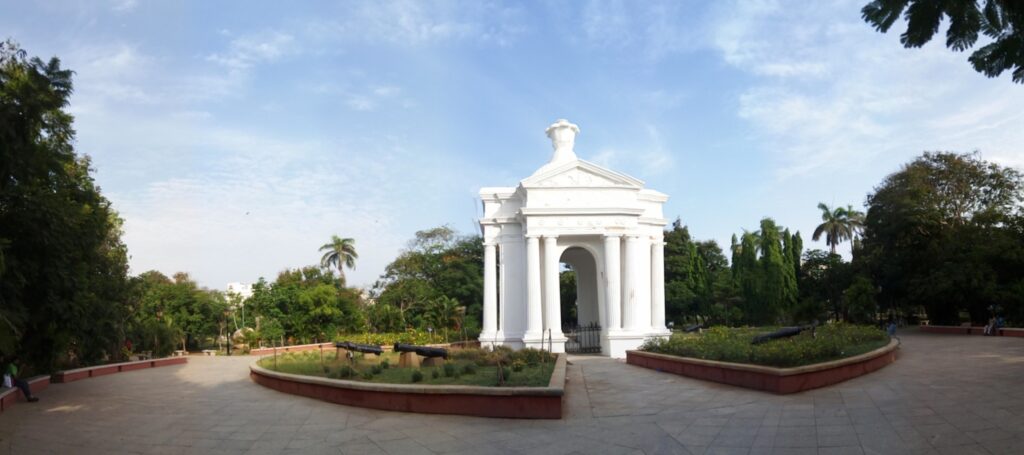
Introduction and Heritage Atmosphere
Bharathi Park & Aayi Mandapam together form one of the most refreshing and historically evocative spaces in Puducherry’s White Town. Located in the heart of the French Quarter, this green public park offers a calm escape from the busy coastal promenade, cafés, and heritage streets. Surrounded by important colonial buildings, museums, and administrative landmarks, Bharathi Park creates a distinctive “heritage park” atmosphere where nature and history coexist.
At the centre of the park stands Aayi Mandapam, a striking white monument whose elegant form instantly evokes French architectural style. For visitors, the combination of greenery, open space, and classical design makes this site an ideal place to pause, relax, and reflect while exploring Puducherry’s layered past.
Origins and Historical Context
Bharathi Park has its origins in the French colonial period, when urban planners sought to create structured public spaces inspired by European city design. During the nineteenth century, the park was known as Place du Gouvernement and served as an important civic space in the colonial capital of French India. It was designed not only as a recreational area but also as a symbolic centre of colonial administration and urban order.
Over time, the park became an integral part of Puducherry’s public life. After India’s independence and the integration of Puducherry into the Indian Union, the park was renamed Bharathi Park in honour of the Tamil poet and freedom thinker Subramania Bharati, who had strong connections with the city. This renaming reflects the transition from colonial identity to modern Indian cultural memory.
Aayi Mandapam: Architecture and Symbolism
Aayi Mandapam is the visual and symbolic focal point of Bharathi Park. Built during the French colonial era, the monument is characterised by its clean white façade, symmetrical proportions, and classical design. Its architectural style reflects European neoclassical influences, adapted to the tropical context of Puducherry.
The structure stands out not through excessive ornamentation but through simplicity and balance. Its elegant form contrasts beautifully with the surrounding greenery, making it one of the most photographed landmarks in White Town. For many visitors, Aayi Mandapam represents the visual essence of “French Puducherry”—refined, orderly, and timeless.
Beyond its aesthetic appeal, the monument symbolises the cultural dialogue between Europe and India. While its design is European in inspiration, its presence within an Indian urban landscape reflects the hybrid identity that defines Puducherry.
Role in White Town’s Urban Landscape
Bharathi Park plays a crucial role in shaping the spatial and cultural identity of White Town. Surrounded by landmarks such as the Puducherry Museum, Raj Niwas, government buildings, and heritage streets, the park acts as a green core within the colonial city layout. It provides visual relief from dense architecture and serves as a meeting point between nature and built heritage.
For visitors walking through White Town, Bharathi Park functions as a natural transition space between different attractions. After exploring churches, museums, and promenades, the park offers a moment of calm that enhances the overall heritage experience. Its location makes it a strategic stop in any heritage walk itinerary.
Experience for Visitors and Travellers
For travellers, Bharathi Park and Aayi Mandapam offer a gentle, unhurried experience that contrasts with the more crowded tourist spots in Puducherry. The shaded pathways, open lawns, and quiet corners make the park ideal for relaxed walks, casual photography, and moments of reflection. Families, couples, and solo travellers alike find the park appealing for its peaceful ambience.
The site is especially attractive to those who prefer subtle heritage experiences rather than grand monuments. Instead of dramatic architecture or large-scale attractions, Bharathi Park offers understated beauty and historical resonance. Aayi Mandapam, in particular, appeals to photographers and heritage enthusiasts who appreciate symmetry, light, and architectural elegance.
Cultural and Symbolic Significance
Bharathi Park and Aayi Mandapam together symbolise Puducherry’s layered identity. The park reflects the colonial tradition of planned public spaces, while its modern name and usage reflect Indian cultural continuity. Aayi Mandapam embodies the aesthetic ideals of French architecture while existing within a distinctly Indian social environment.
This dual identity makes the site particularly meaningful. It illustrates how Puducherry did not simply abandon its colonial past but reinterpreted it within a modern cultural framework. The park thus represents both historical memory and contemporary public life.
Bharathi Park & Aayi Mandapam in the Present Day
Today, Bharathi Park continues to function as one of Puducherry’s most cherished public spaces. It remains a popular spot for residents and tourists alike, offering a balance between leisure, heritage, and urban life. Aayi Mandapam continues to stand as a visual landmark, anchoring the park’s identity and reinforcing the French character of White Town.
As Puducherry grows as a tourist destination, Bharathi Park and Aayi Mandapam retain their relevance as spaces of calm and continuity. They remind visitors that the city’s heritage is not only preserved in buildings and monuments but also in public spaces where people gather, relax, and engage with history.
Ultimately, Bharathi Park and Aayi Mandapam represent the quieter, greener side of Puducherry’s heritage. They offer travellers a chance to experience the city beyond beaches and architecture, revealing how nature, colonial planning, and modern life intertwine in one harmonious urban landscape. Together, they stand as enduring symbols of Puducherry’s ability to balance history and leisure, memory and modernity, within a single, elegant space.