
Imperial Foundation and Sacred Location
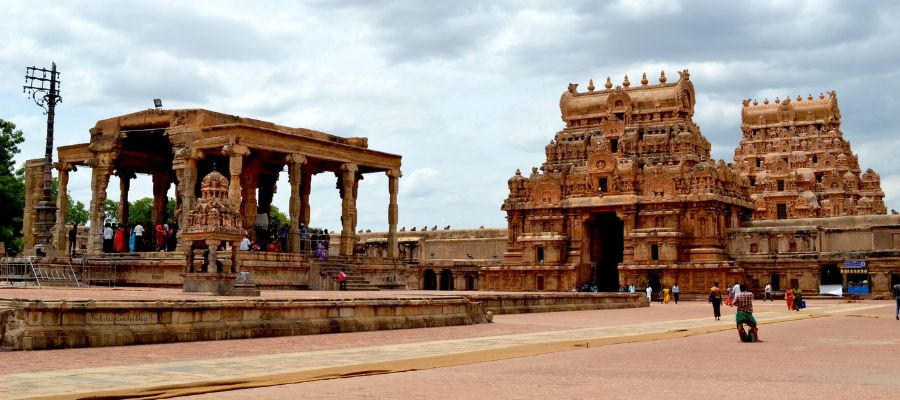
The Brihadisvara Temple, also known as the Big Temple, is one of the most monumental Hindu temples in India, located in Thanjavur, Tamil Nadu. Dedicated to Lord Shiva, the temple stands as a grand expression of Chola imperial power and religious devotion. Its scale, architectural precision, and historical significance place it among the most remarkable achievements of South Indian temple architecture.
Situated in the heart of Thanjavur, the temple forms the core of the city’s historical identity, linking royal authority, religious practice, and urban development within a single sacred complex.
Chola Vision and Historical Development
The Brihadisvara Temple was built in the early 11th century under the reign of Raja Raja Chola I, one of the greatest rulers of the Chola dynasty. The construction of such a massive temple reflected not only religious faith but also the political ambition and administrative strength of the Chola Empire.
The temple served as a centre of royal patronage, ritual authority, and economic activity. Later Chola rulers and subsequent dynasties maintained and expanded the temple complex, ensuring its continuity across centuries.
Inscriptions on temple walls provide detailed records of donations, land grants, temple administration, and social organisation, offering valuable insights into medieval South Indian society and governance.
Monumental Architecture and Engineering
Architecturally, the Brihadisvara Temple represents the peak of Dravidian temple construction. The most striking feature is the massive vimana (tower) above the sanctum, rising to a height of over 60 metres, making it one of the tallest temple towers in India.
The temple complex includes a vast courtyard, towering gopurams, pillared halls, subsidiary shrines, and monumental sculptures. The central sanctum houses a gigantic Shiva lingam, reflecting the temple’s spiritual and architectural grandeur.
One of the most remarkable aspects of the temple is the engineering skill involved in constructing the vimana using massive granite blocks. The precision of stone carving and structural design demonstrates advanced technical knowledge achieved by Chola architects.
Temple Administration and Ritual System
Brihadisvara Temple functioned as a major institutional centre during the Chola period. It supported a large community of priests, dancers, musicians, artisans, and administrators who sustained temple rituals and cultural activities.
Daily worship, elaborate ceremonies, and seasonal festivals formed the core of temple life. The temple was also connected to classical performing arts, particularly Bharatanatyam and temple music traditions, which flourished under royal patronage.
Through its ritual system, the temple reinforced the connection between imperial authority and religious legitimacy in Chola society.
Cultural and Political Influence
Beyond its religious role, the Brihadisvara Temple symbolised the power and cultural sophistication of the Chola Empire. It served as a visual statement of imperial authority, visible across the Thanjavur landscape.
The temple influenced the development of South Indian architecture, inspiring later temple-building traditions across Tamil Nadu and beyond. Its artistic style, sculptural forms, and spatial organisation became models for subsequent generations of temple architects.
The temple also shaped Thanjavur’s identity as a centre of culture, learning, and administration, strengthening its position within the Chola political network.
Experience for Pilgrims and Visitors
For pilgrims, the Brihadisvara Temple offers a powerful devotional experience centred on Shiva worship. Devotees participate in daily rituals, special pujas, and major festivals such as Maha Shivaratri and annual Brahmotsavam.
For visitors and heritage travellers, the temple provides an immersive encounter with monumental architecture, historical inscriptions, and sculptural artistry. The vast open courtyard, towering vimana, and rhythmic arrangement of pillars create a sense of scale rarely found in other temple complexes.
The temple is often explored alongside nearby heritage sites such as the Thanjavur Maratha Palace and Saraswathi Mahal Library, forming a comprehensive cultural itinerary.
Brihadisvara Temple in the Present Context
Today, the Brihadisvara Temple continues to function as both an active place of worship and a protected heritage monument. Recognised as a UNESCO World Heritage Site, the temple is subject to conservation programmes and heritage management initiatives aimed at preserving its architectural integrity.
The temple attracts large numbers of pilgrims, tourists, scholars, and art historians from across India and abroad, reinforcing Thanjavur’s status as a major cultural and religious centre. At the same time, traditional rituals, festival cycles, and temple administration remain active, maintaining continuity between Chola-era traditions and contemporary religious practice.