
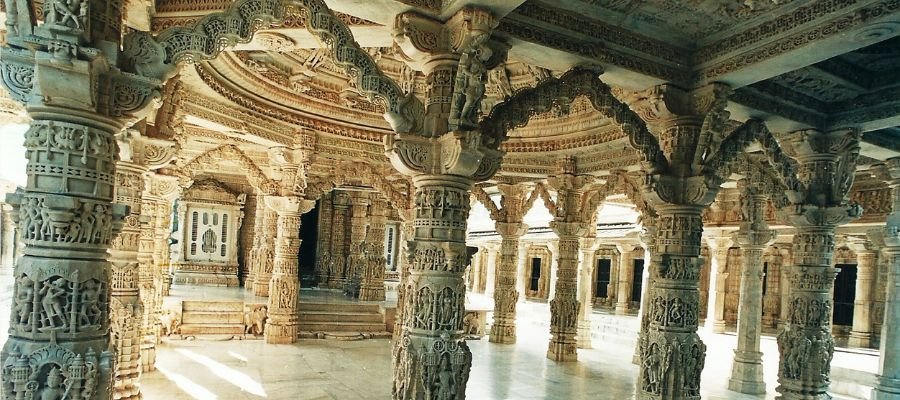
The Dilwara Jain Temples sit a little outside the main town, hidden among trees, and from outside they look quite simple. But once you enter, the interiors are some of the most breathtaking stone work in India. Every pillar, ceiling and arch is carved out of pure white marble with delicate lace-like detail—lotus rosettes on ceilings, bands of dancers and elephants on pillars, and entire scenes from Jain mythology frozen in stone. The light inside is soft and cool, making the carvings glow rather than shout. Because photography is usually not allowed inside, visitors are forced to slow down and actually look, which fits the peaceful, meditative atmosphere of these shrines.
About this place
History & highlights
The complex actually consists of five main temples—Vimal Vasahi, Luna Vasahi, Pittalhar, Parshvanath and Mahavir Swami—built between the 11th and 16th centuries CE in the Solanki/Chaulukya style. The earliest, Vimal Vasahi, was commissioned around 1026–1031 CE by Vimal Shah, a minister of the Chaulukya king Bhima I of Gujarat, and dedicated to Rishabhanatha. Later, in 1230, the Luna Vasahi temple was built by the Porwad brothers Tejpal and Vastupal, ministers of the Vaghela rulers, in memory of their brother, and is often seen as the artistic peak of the complex. Over the next centuries, additions like the Parshvanath and Mahavir Swami shrines were made, creating a full Jain pilgrimage circuit. The temples were damaged during Alauddin Khalji’s campaigns in the early 14th century but repeatedly restored by Jain patrons; major repairs were carried out in 1906 and again in the mid-20th century. Today the complex is managed by the Kalyanji–Anandji trust and remains both a living tirtha for Śvetāmbara Jains and a globally famous example of marble temple architecture.
Reviews
No reviews yet. Click “Write a Review” above to share your experience.