
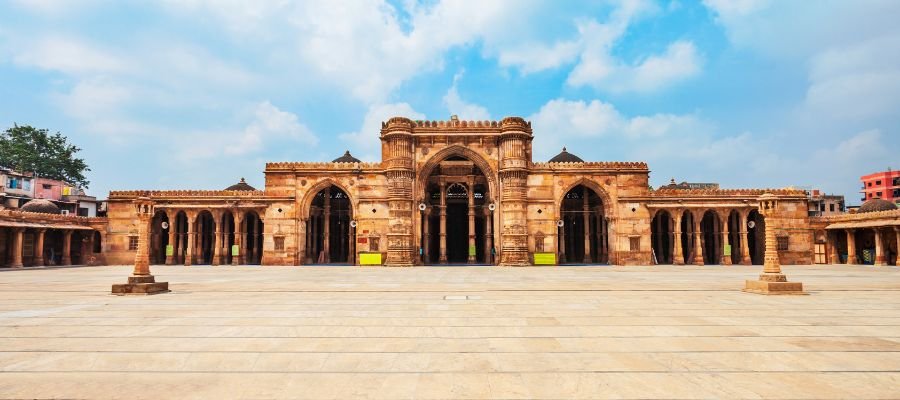
Jama Masjid, near Bhadra Fort in old Ahmedabad, is a grand congregational mosque that once formed the spiritual centre of the sultanate capital. The complex features a spacious stone courtyard with an ablution tank in the middle, surrounded by arcaded cloisters and a large prayer hall topped by multiple domes. The pillars and decorative elements reveal a strong influence of earlier Hindu and Jain temple architecture, as craftsmen adapted familiar motifs to an Islamic setting. The atmosphere shifts through the day: peaceful in the morning, busier during prayer times, and atmospheric in the late afternoon light. Non-Muslim visitors are usually welcome outside main prayer times if they dress modestly and behave respectfully. Together with nearby markets and gateways, Jama Masjid helps visitors imagine how the walled city functioned as a political, commercial and religious centre centuries ago.
About this place
History & highlights
The mosque was commissioned by Sultan Ahmad Shah I, the founder of Ahmedabad, in the early 15th century after he made the city his new capital. It was built as the Friday mosque for the royal city, symbolising both the power and piety of the Gujarat Sultanate. Over time, urban growth surrounded the complex with bazaars and residential quarters, while the mosque itself remained in continuous use as a religious institution. In the modern period it has been recognised as an important heritage monument within Ahmedabad’s UNESCO World Heritage City designation, and periodic conservation work helps maintain its structural and artistic integrity.
Reviews
No reviews yet. Click “Write a Review” above to share your experience.