
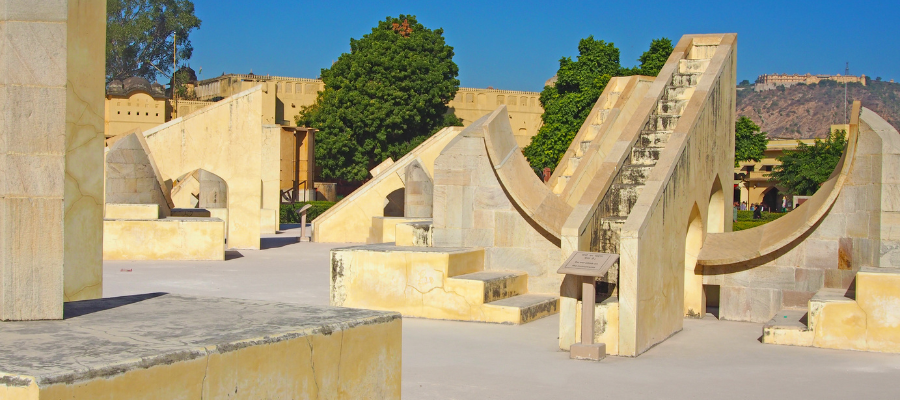
Jantar Mantar is not just a monument; it is an open-air laboratory of giant stone instruments. Spread out in a walled courtyard near City Palace, these 18th-century devices were used to track the movement of the sun, moon and planets with surprising accuracy. The massive Samrat Yantra, a giant sundial, can measure local time to a precision of seconds, while structures like the Jai Prakash and Ram Yantra allowed observations of celestial coordinates. To a visitor it feels almost futuristic, yet everything is built in stone, brick and marble, with no metal telescopes. Guides often demonstrate how shadows and markings on the instruments still work today, turning abstract astronomy into something immediate and visual.
About this place
History & highlights
The Jaipur Jantar Mantar is one of a chain of observatories built by Sawai Jai Singh II in the early 18th century, the others being in Delhi, Ujjain, Mathura and Varanasi. A keen astronomer and scholar, Jai Singh was dissatisfied with the accuracy of existing astronomical tables, so he commissioned large masonry instruments that reduced observational errors. Construction of the Jaipur observatory was completed around 1734–1738, and it became the most sophisticated of his observatories, with around twenty main instruments. Over time, as Western telescopic astronomy spread under the British, active scientific use declined, but the structures survived as historical curiosities. In 2010, Jantar Mantar, Jaipur was inscribed as a UNESCO World Heritage Site, recognised for representing the scientific and cosmological knowledge of an 18th-century Indian royal court.
Reviews
No reviews yet. Click “Write a Review” above to share your experience.