
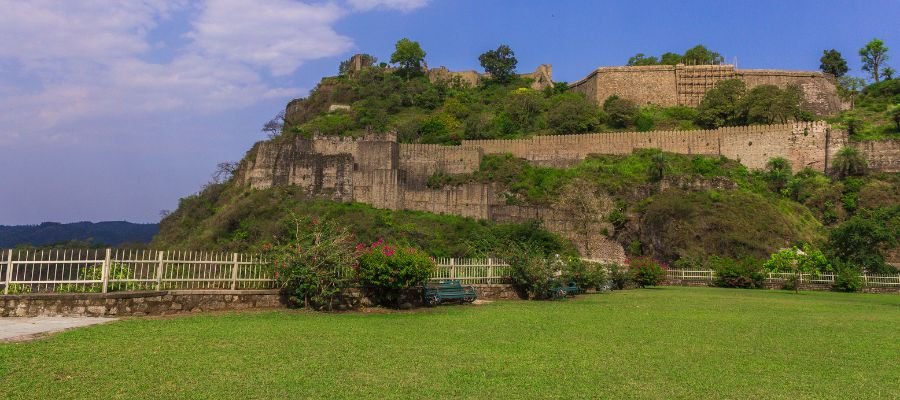
Kangra Fort stands dramatically on a hill spur where the Manjhi and Banganga rivers meet, with steep cliffs on three sides and stone walls rising above the valley. It is considered the largest fort in the Himalayas, with multiple gateways, inner courtyards and ruins of palaces, water tanks and temples. From the top, views stretch across the Kangra Valley to the snowy Dhauladhar, so visitors experience both a powerful historic monument and a natural viewpoint. Small shrines inside the fort and a nearby museum preserve sculptures and artefacts from different eras of its long life.
About this place
History & highlights
The fort is traditionally attributed to the Katoch rulers of Trigarta and is often described as one of India’s oldest continuously mentioned forts, with archaeological remains of Jain and Hindu temples dating to around the 9th–10th century CE. Its recorded history includes Mahmud of Ghazni’s famous plunder in 1009 CE, repeated struggles with Delhi Sultans, and sieges by the Mughals, who finally took full control under Jahangir in 1620. In the late 18th–early 19th century Maharaja Sansar Chand Katoch tried to restore Katoch power from here until Ranjit Singh’s Sikh forces captured the fort; the British later occupied it after the Anglo-Sikh wars. The 1905 earthquake caused heavy damage, leaving it in romantic ruins now protected by the Archaeological Survey of India.
Reviews
No reviews yet. Click “Write a Review” above to share your experience.