
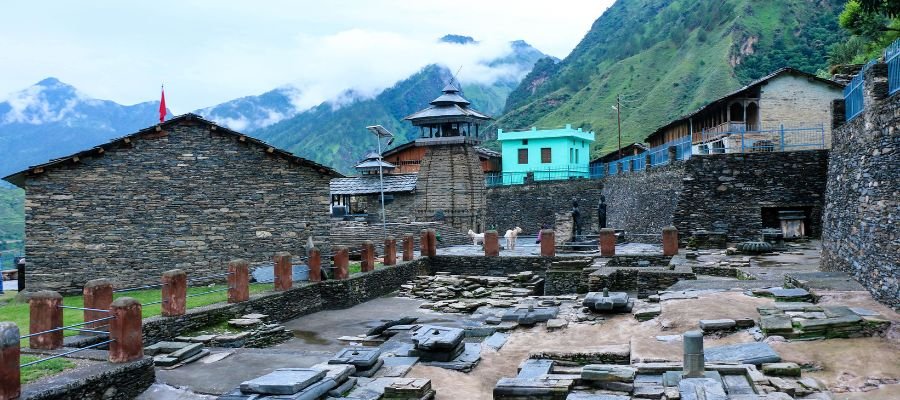
Lakhamandal Temple is a major ancient Shiva temple complex in the Jaunsar–Bawar region, in Dehradun district but commonly visited from Chakrata side. The complex includes a main stone temple in Nagara style, many scattered shrines and hundreds of small Shivalingas around the courtyard. The most famous feature is its graphite Shivling, which shines and reflects surroundings when wet. The setting – traditional village, Yamuna valley nearby, terraced fields and old carved stones – gives it a very powerful spiritual and archaeological atmosphere.
About this place
History & highlights
Archaeology and inscriptions suggest that Lakhamandal saw temple construction as early as the 6th century CE, with the present main shrine dated roughly to the 12th–13th century CE. The name comes from “Lakha” (many) + “Mandal” (temples/lingas), referring to the large number of lingas and shrines. Excavations by the Archaeological Survey of India have uncovered sculptures and architectural fragments, confirming that it was once a big Shaivite centre. Local tradition strongly links Lakhamandal to the Mahabharata – this is believed to be the region of the Lakshagriha (house of lac) where Duryodhana plotted to burn the Pandavas, and caves nearby are said to be where the Pandavas escaped. Today Lakhamandal is both a protected ASI site and a living pilgrimage, drawing devotees as well as history lovers from Dehradun, Chakrata, Mussoorie and beyond.
Reviews
No reviews yet. Click “Write a Review” above to share your experience.