
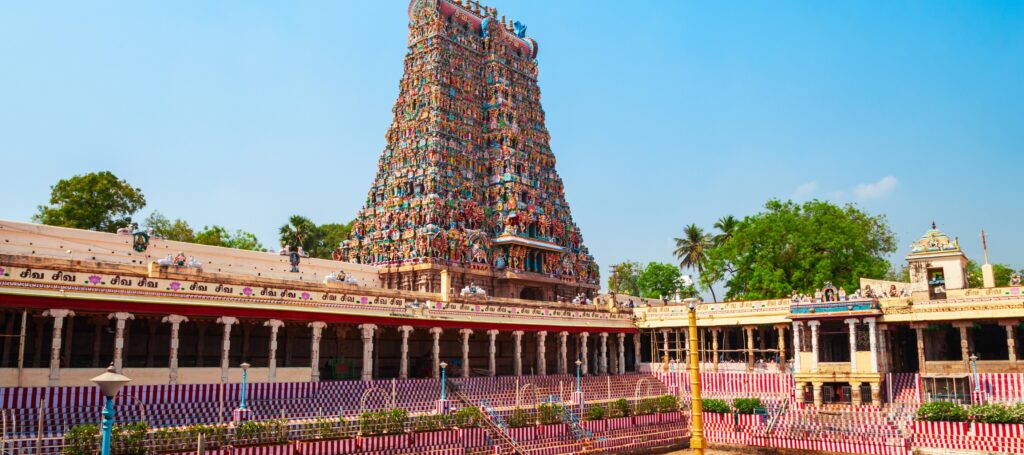
Sacred Core of Madurai
The Meenakshi Amman Temple is one of the most celebrated and architecturally elaborate temples in India, located in the centre of Madurai, Tamil Nadu. Dedicated to Goddess Meenakshi and Lord Sundareswarar (Shiva), the temple forms the spiritual and spatial heart of the city. Unlike many temples that function as isolated sacred sites, the Meenakshi Amman Temple developed as the nucleus around which Madurai’s urban life, economy, and culture evolved.
The temple’s prominence in Tamil religious tradition and its role in shaping Madurai’s identity have made it one of the most significant centres of worship in South India.
Mythological Origins and Historical Continuity
The origins of the Meenakshi Amman Temple are rooted in ancient Tamil mythology and local legends associated with Goddess Meenakshi, regarded as the divine ruler of Madurai. Literary sources and oral traditions describe the goddess as both a warrior queen and a manifestation of divine power.
Historically, the temple evolved through multiple phases of construction and expansion. Early structures are believed to date back to ancient periods, while major architectural development occurred under the Pandya dynasty, which patronised the temple as a royal and religious institution.
Later, the temple was expanded significantly during the Nayak period, when rulers such as Thirumalai Nayak added gopurams, mandapams, and ceremonial spaces, transforming the complex into a monumental temple city.
Architectural Complexity and Temple Layout
Architecturally, the Meenakshi Amman Temple is renowned for its vast scale and intricate Dravidian design. The complex is organised around multiple enclosures, towering gopurams, sacred tanks, and pillared halls.
The temple features numerous gopurams adorned with thousands of colourful sculptures depicting deities, mythological figures, and symbolic motifs. The twin sanctums dedicated to Meenakshi and Sundareswarar form the ritual centre of the complex, while structures such as the Thousand Pillared Hall and the Golden Lotus Tank add to its architectural richness.
The spatial arrangement of the temple reflects centuries of architectural evolution and ritual planning, integrating sacred, ceremonial, and civic functions within a single complex.
Ritual Life and Festival Traditions
The Meenakshi Amman Temple is a major centre of Shaiva–Shakta worship. Daily rituals follow elaborate liturgical systems that sustain continuous temple activity. Priests, musicians, and service communities contribute to the temple’s ritual rhythm.
Major festivals such as the Chithirai Thiruvizha, including the celestial wedding of Meenakshi and Sundareswarar, attract massive gatherings of devotees and visitors. Annual processions, temple ceremonies, and seasonal celebrations transform the temple into a vibrant public space.
The temple’s ritual calendar influences Madurai’s social and cultural life, linking religious observance with community identity.
Interaction with Madurai’s Urban and Economic Life
The Meenakshi Amman Temple has historically shaped Madurai’s urban structure. Streets radiate from the temple complex, forming concentric patterns that organise markets, residential areas, and administrative zones.
The temple also functioned as a major economic institution, supporting artisans, traders, and service groups. Traditional markets around the temple continue to reflect this historical relationship between sacred space and commercial activity.
The integration of temple and city life makes the Meenakshi Amman Temple a defining element of Madurai’s identity as a temple-centred urban environment.
Experience for Pilgrims and Cultural Travellers
For pilgrims, the Meenakshi Amman Temple offers an immersive devotional experience combining architecture, ritual, and sacred atmosphere. Devotees participate in daily worship, festival events, and ceremonial processions.
For visitors and cultural travellers, the temple provides insight into Dravidian architecture, Tamil religious traditions, and living heritage practices. The dense sculptural decoration, monumental gateways, and dynamic temple spaces create a powerful sensory experience.
The temple is often explored alongside nearby landmarks such as Thirumalai Nayakkar Mahal and traditional market streets, forming a comprehensive cultural itinerary.
Meenakshi Amman Temple in the Present Context
Today, the Meenakshi Amman Temple continues to function as one of India’s most active and influential temple complexes. Temple administration, heritage conservation, and infrastructure development support the management of large pilgrim flows and preservation of its architectural heritage.
The temple attracts millions of devotees and tourists each year, reinforcing Madurai’s status as a major religious and cultural centre. Daily rituals, festival cycles, and temple-based traditions remain central to the city’s public life, maintaining continuity between historical temple culture and contemporary urban practice.