
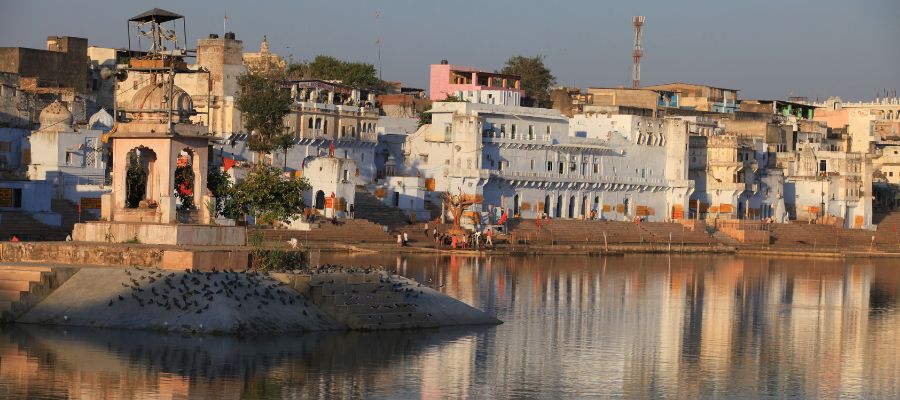
Pushkar Lake (Pushkar Sarovar) is the heart of the town – a deep blue oval of water ringed by 52 bathing ghats and whitewashed houses, with hills on three sides and the Brahma temple above. The steps are always active: priests doing puja, pilgrims taking dips, aarti flames at dusk, and photographers capturing reflections of domes and arches in the water. Some ghats are famous for specific rituals – Brahma Ghat, Varaha Ghat, Gau Ghat, Jaipur Ghat, Kota Ghat, Saptarishi Ghat – and at Kartik Purnima the entire lake glows with diyas when thousands come for the holy bath. Even outside festival time, the sound of bells, Sanskrit chants, birds and temple music gives Pushkar Lake a continuously sacred atmosphere.
About this place
History & highlights
Hindu tradition says Pushkar is “Tirtha-Raj / Tirtha-Guru” – king of sacred lakes, created when Lord Brahma dropped a lotus while slaying the demon Vajranabha; where the petals fell, three lakes formed, with this one as Jyeshtha Pushkar, the main lake. Archaeological and textual evidence shows Pushkar Lake already existed as a pilgrimage centre by at least the 4th century BCE, since its name appears on ancient coins. As a water body it is artificial: in the 12th century a dam was built across the headwaters of the Luni River to enlarge and stabilise the lake, and over time rulers, merchants and sects built ghats and temples around it. During Mughal rule, pilgrim taxes and restrictions temporarily reduced its importance, but emperors like Jahangir still stayed here for hunting and politics. Today the lake is at the centre of intense debates on ecology and construction—priests and environmentalists warn of pollution, illegal hotels in the catchment and borewells replacing natural rainwater, while the state has announced large projects (₹200+ crore) to restore ghats, block sewage inflow and “beautify” the sacred waterfront.
Reviews
No reviews yet. Click “Write a Review” above to share your experience.