
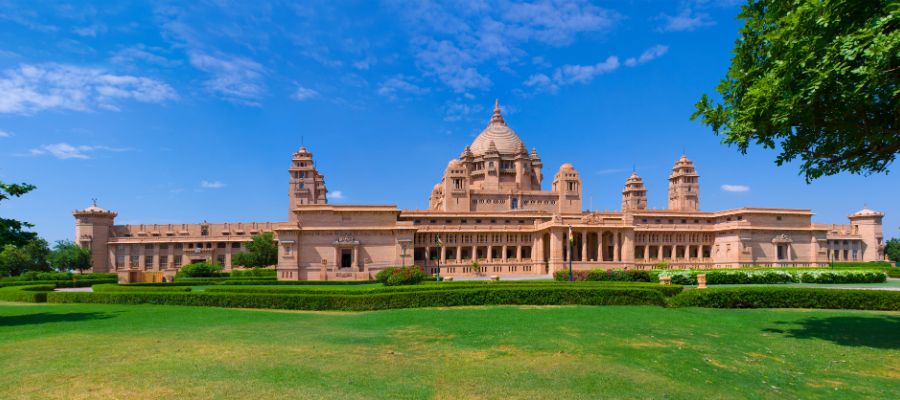
Umaid Bhawan Palace crowns Chittar Hill in golden-yellow sandstone, looking more like an Art Deco monument than a typical Rajput palace. A massive central dome rises above long wings with colonnades, courtyards and formal gardens. Inside, the décor mixes Western Art Deco with Indian motifs—high-ceilinged halls, marble staircases, a grand Durbar Hall and richly furnished suites. Today the complex is divided into three parts: a luxury Taj hotel, a museum displaying vintage cars and royal memorabilia, and a private residence where the current Jodhpur royal family still lives. Weddings, film shoots and luxury stays have made the palace a modern symbol of Jodhpur’s royal glamour.
About this place
History & highlights
Umaid Bhawan was commissioned by Maharaja Umaid Singh in the late 1920s, partly as a famine-relief project to provide employment to thousands of people during severe droughts in Marwar. Groundbreaking took place in 1929, and construction continued until 1943, using locally quarried sandstone brought on a special railway line to the site. British architect Henry Vaughan Lanchester designed the palace in a hybrid Indo-Deco / Indo-Saracenic style, blending classical symmetry, Art Deco interiors and Rajput motifs, while Polish artist J.S. Norblin created interior frescoes. After independence, falling royal revenues led the family to open part of the building as a hotel (now run by Taj) and a public museum, while retaining a section as their principal home—making it one of the world’s largest still-inhabited palaces.
Reviews
No reviews yet. Click “Write a Review” above to share your experience.