
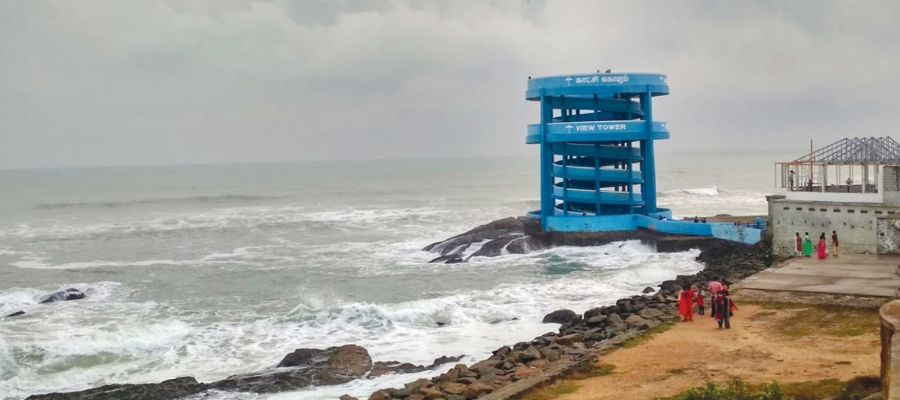
Introduction and Visual Identity
The View Tower is one of the simplest yet most rewarding attractions in Kanyakumari, offering visitors an elevated perspective of the town’s dramatic coastline. Unlike grand monuments or spiritual landmarks, the tower’s value lies in its viewpoint rather than its architecture. From the top, travellers can understand the geography of Kanyakumari in a single glance—the meeting of seas, the curve of the shoreline, the placement of monuments, and the rhythm of the coastal town.
For first-time visitors, the View Tower serves as a visual orientation point. It helps them “read” the landscape of Kanyakumari, transforming scattered sights into a coherent picture. For photographers and curious travellers, it offers a rare opportunity to capture wide, panoramic frames that are impossible to obtain from crowded beaches or narrow streets.
Purpose and Role in Tourism
The View Tower was developed as part of Kanyakumari’s tourism infrastructure to enhance visitors’ experience of the coastal environment. Rather than being a historical structure, it functions as a modern observation point designed to complement the town’s natural and cultural attractions.
In a destination where most experiences happen at ground level—on beaches, promenades, and temple courtyards—the View Tower introduces a vertical dimension to tourism. It allows visitors to step back from the immediate sensory experience and observe Kanyakumari from a broader spatial perspective. This shift in viewpoint adds depth to the travel experience, making the tower a valuable yet often understated attraction.
Panoramic Views and Coastal Geography
From the top of the View Tower, visitors can witness Kanyakumari’s unique geographical setting. The vast expanse of the Arabian Sea, the Bay of Bengal, and the Indian Ocean appears as a continuous horizon, while the coastline reveals its natural curves and rocky formations. Landmarks such as the Vivekananda Rock Memorial, Thiruvalluvar Statue, beaches, and promenades become visually connected within a single frame.
This panoramic perspective highlights the spatial relationships between Kanyakumari’s attractions. Visitors can see how monuments, religious sites, and tourist zones are positioned relative to the sea, offering insights into how geography has shaped the town’s cultural and historical development.
Photography and Visual Storytelling
One of the View Tower’s greatest attractions is its potential for photography. From its height, visitors can capture wide-angle shots of the coastline, sunsets, and urban landscape. These images often feel more cinematic and expansive than photographs taken at ground level, where crowds and obstacles limit visual composition.
For travel enthusiasts and content creators, the tower provides a vantage point that transforms ordinary scenes into striking visual narratives. The interplay of sea, sky, architecture, and movement creates dynamic compositions that reflect the essence of Kanyakumari.
Experience for First-Time Visitors
For first-time travellers, the View Tower offers clarity and orientation. Kanyakumari can feel visually overwhelming, with multiple monuments, beaches, and viewpoints spread across the town. By ascending the tower, visitors gain a mental map of the area, making it easier to plan their exploration.
The tower is also a low-effort attraction. Unlike long walks or physically demanding activities, it requires minimal time and energy, making it suitable for families, elderly travellers, and those with limited schedules. This accessibility enhances its appeal as a convenient stop between major attractions.
Symbolic Value in the Tourist Journey
Beyond its practical benefits, the View Tower holds symbolic value in the travel experience. It represents a moment of pause and perspective within the journey. By rising above the immediate environment, visitors can reflect on the broader landscape and their place within it.
In a destination known for spiritual symbolism and natural grandeur, the View Tower offers a different kind of insight—one based on observation and visual understanding rather than religious or historical narratives. It complements Kanyakumari’s deeper meanings with a simple yet powerful visual experience.
View Tower in the Present Day
Today, the View Tower remains a modest but meaningful attraction in Kanyakumari’s tourism ecosystem. While it may not draw the same attention as iconic monuments or temples, it continues to serve travellers who value perspective, photography, and spatial awareness.
As Kanyakumari evolves as a tourist destination, the View Tower retains its relevance as a practical and experiential landmark. It bridges the gap between sightseeing and understanding, between movement and observation.
Ultimately, the View Tower is not just a structure but a viewpoint—both literally and metaphorically. It offers visitors a chance to see Kanyakumari from above, to connect its landmarks within a single visual narrative, and to capture moments that transcend ground-level experience. For travellers seeking a broader perspective of the coastline, the View Tower stands as a quiet yet valuable highlight in the journey through India’s southernmost town.